


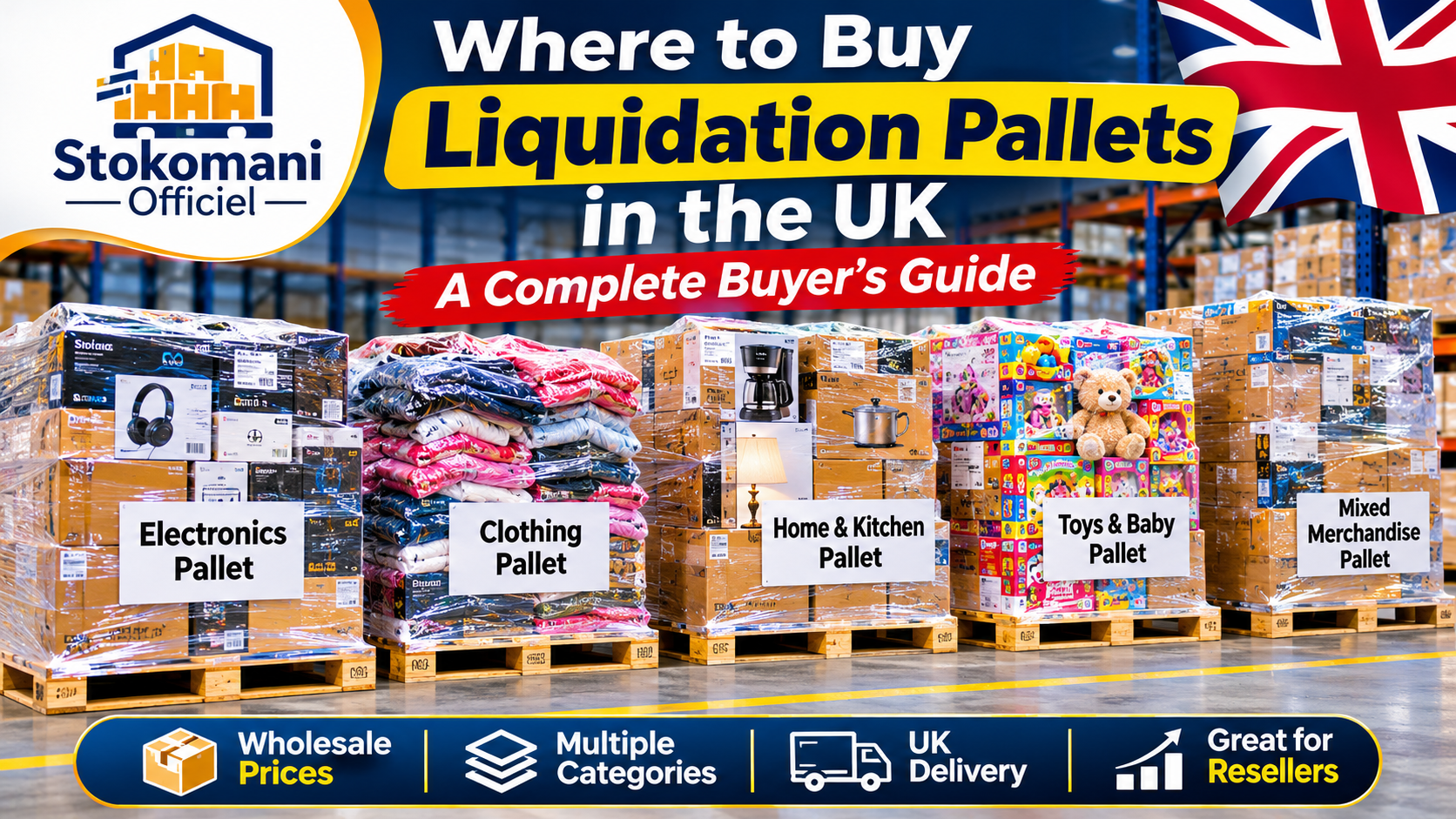
Buying liquidation pallets in the UK can be an effective way for retailers, online sellers and independent resellers to source products in bulk at competitive prices. From electronics and household appliances to clothing, toys, furniture and mixed merchandise, liquidation stock offers buyers access to different product categories without purchasing every item individually.
However, finding the right liquidation pallet supplier requires more than comparing advertised prices. Buyers need to understand the different types of liquidation stock, product conditions, pallet manifests, delivery arrangements and potential resale margins before placing an order.
Whether you operate an established retail business, sell through eBay and Amazon, manage an online shop or are exploring wholesale opportunities for the first time, choosing suitable liquidation pallets can help you build a more diverse product inventory.
In this guide, we explain where to buy liquidation pallets in the UK, what to look for when comparing suppliers, which types of pallets are available and how to make more informed purchasing decisions.
What Are Liquidation Pallets?
Liquidation pallets are bulk collections of merchandise sold together, usually because a retailer, distributor, manufacturer or wholesaler needs to clear surplus inventory.
These pallets can contain different types of products depending on their original source and reason for liquidation.
Common examples include:
- Customer-returned merchandise.
- Excess retail inventory.
- Overstock products.
- Discontinued product lines.
- End-of-season merchandise.
- Packaging-damaged goods.
- Clearance and surplus stock.
- Mixed-category wholesale products.
Liquidation pallets are commonly purchased by wholesalers, market traders, independent retailers and online resellers looking to acquire merchandise in larger quantities.
The contents and condition of each pallet can vary considerably. Some contain unused products, while others include customer returns, damaged packaging or items requiring inspection.
Understanding these differences is essential when deciding which liquidation pallet is suitable for your business.
Where to Buy Liquidation Pallets in the UK
There are several ways to source liquidation pallets in the UK. Each purchasing route offers different advantages depending on your budget, preferred product categories, buying quantities and resale objectives.
1. Specialist Liquidation Pallet Suppliers
Specialist liquidation suppliers purchase or source surplus merchandise, customer returns and clearance inventory and make it available to buyers in pallet or bulk quantities.
This is one of the most accessible purchasing routes for resellers who want to compare different types of stock without negotiating directly with individual retailers.
When choosing a liquidation supplier, consider:
- The range of available product categories.
- Whether pallet contents are described accurately.
- Whether product manifests are available.
- The stated condition of the merchandise.
- Minimum order quantities.
- Delivery arrangements and associated costs.
- Business registration and contact information.
A reliable supplier should be able to explain what is included in a particular pallet and provide clear purchasing terms.
2. Online Wholesale and Liquidation Platforms
Online wholesale platforms allow buyers to browse available liquidation merchandise without visiting multiple physical warehouses.
Depending on the platform, buyers may find individual pallets, mixed merchandise lots, electronics, clothing, household products and larger wholesale quantities.
Before purchasing through an online platform, check whether the listed merchandise is sold directly by the platform or by an independent third-party seller.
You should also review the listing photographs, product descriptions, condition information, payment terms and delivery arrangements.
3. Wholesale Clearance Suppliers
Wholesale clearance suppliers specialise in selling excess inventory, discontinued products and merchandise that businesses need to move quickly.
These suppliers can be particularly useful for retailers and resellers looking for new or unused products in bulk.
Some clearance opportunities involve individual product categories, while others contain mixed merchandise.
The important consideration is whether the stock matches the products your customers actually purchase.
4. Business Liquidation Auctions
Another purchasing option is business liquidation auctions.
When companies close, restructure or dispose of surplus inventory, their merchandise may be sold through auction houses or specialist liquidation channels.
Buyers can sometimes find large quantities of stock through these sales.
However, auction purchases require careful financial planning. Always account for buyer premiums, collection charges, transport costs and any applicable taxes before deciding how much to bid.
Types of Liquidation Pallets Available in the UK
Choosing the correct pallet category is one of the most important parts of wholesale purchasing.
Different products appeal to different customer groups, and not every category is suitable for every resale business.
Electronics Liquidation Pallets
Electronics pallets can contain products such as:
- Headphones and audio accessories.
- Computer accessories.
- Small electronic devices.
- Gaming accessories.
- Mobile phone accessories.
- Home electronics.
- Electrical appliances.
Electronics can attract strong consumer interest, but buyers should pay particular attention to testing, functionality, missing accessories and product compatibility.
For higher-value electrical products, verify applicable safety and conformity requirements before resale.
Clothing and Fashion Liquidation Pallets
Clothing pallets can include:
- Men’s clothing.
- Women’s clothing.
- Children’s clothing.
- Shoes and footwear.
- Fashion accessories.
- Seasonal apparel.
- Mixed clothing collections.
Fashion liquidation stock can be suitable for independent clothing retailers, market traders and online fashion sellers.
Before purchasing, consider the size distribution, seasonality, product condition and styles included in the lot.
Home and Kitchen Liquidation Pallets
Homeware and kitchen pallets can contain:
- Kitchen utensils.
- Small household appliances.
- Storage products.
- Home accessories.
- Decorative merchandise.
- Bedding and household textiles.
- Cleaning accessories.
These products can appeal to general merchandise retailers and online sellers who want to expand their product selection.
Toys and Baby Products Pallets
This category may include toys, children’s accessories, nursery products and other baby-related merchandise.
Buyers should carefully inspect age recommendations, labelling, completeness and applicable product safety requirements.
Do not assume that returned or untested products are suitable for resale, particularly where children’s safety is concerned.
Mixed Merchandise Liquidation Pallets
Mixed merchandise pallets contain products from several categories.
Depending on the supplier and stock source, a pallet might include household goods, accessories, toys, electronics, clothing and other consumer products.
Mixed pallets can be attractive to general merchandise retailers because they provide access to a broader inventory.
However, buyers should examine the product mix carefully to avoid purchasing large quantities of items that do not suit their target customers.
How to Choose the Right Liquidation Pallet Supplier
Finding a supplier is only the beginning. The quality of your purchasing decision depends on how carefully you evaluate the business and its merchandise.
Here are seven important factors to consider.
1. Verify the Supplier’s Business Details
Before transferring money, establish who you are buying from.
Check the supplier’s legal business identity, registration information, physical business address and contact details.
Where possible, look for independent business reviews and evidence of previous trading activity.
Be particularly cautious when a seller refuses to provide verifiable business information.
2. Understand the Product Condition
Liquidation merchandise can be sold in several condition categories.
Common descriptions include:
- New: Products described as unused and in new condition.
- Open-box: Products with opened packaging, potentially unused.
- Customer returns: Merchandise previously returned by customers.
- Damaged packaging: Products with packaging damage, which may or may not affect the merchandise.
- Untested: Products that have not undergone functionality testing.
- Salvage: Merchandise that may be damaged or unsuitable for ordinary resale.
Condition terminology varies between suppliers. Always request the supplier’s written grading definitions rather than assuming that two sellers use identical standards.
3. Request a Pallet Manifest
A pallet manifest is a document describing the merchandise included in a pallet or wholesale lot.
Depending on the supplier, it may include:
- Product descriptions.
- Product quantities.
- Model numbers.
- Product categories.
- Condition information.
- Reference retail values.
A manifest can help buyers estimate whether a pallet is suitable for their business.
However, a manifest is not automatically a guarantee of resale value or profitability. Check whether the information represents confirmed contents, estimated quantities or indicative product values.
If a pallet is unmanifested, understand that you are accepting greater uncertainty about its contents.
4. Compare the Total Purchase Cost
The advertised pallet price is not necessarily the final amount you will spend.
Your purchasing calculations should include:
- Pallet purchase price.
- Delivery and freight charges.
- Applicable VAT and other taxes.
- Import or customs costs, where relevant.
- Storage expenses.
- Sorting and handling costs.
- Testing and repair expenses.
- Packaging and resale preparation.
Calculating the total landed cost gives you a more realistic picture of the financial commitment.
5. Check Delivery Arrangements
Delivery is an important consideration when purchasing liquidation pallets.
Before ordering, confirm:
- The dispatch location.
- The delivery destination.
- The number of pallets included.
- Whether delivery is kerbside or to a specified location.
- Whether unloading equipment is required.
- Estimated delivery times.
- Insurance and damage procedures.
For larger orders, request a written freight quotation before confirming the purchase.
6. Review Payment and Refund Terms
Understand the supplier’s payment requirements before committing to an order.
Request an invoice and written confirmation of the merchandise being purchased.
Check the supplier’s policies regarding damaged deliveries, missing merchandise, incorrect descriptions and cancellation requests.
Avoid making payments to unrelated personal accounts without independently verifying the transaction.
7. Start With a Manageable Purchase
If you have never purchased from a particular supplier, consider beginning with an order that matches your available budget and storage capacity.
This gives you an opportunity to assess the accuracy of product descriptions, delivery arrangements and the overall buying experience.
You can use the experience to make more informed decisions about future bulk purchases.
Are Liquidation Pallets Profitable for Resellers in the UK?
Liquidation pallets can offer resale opportunities, but profitability is never guaranteed.
The financial outcome depends on the original purchase price, merchandise condition, product demand, selling prices and the costs involved in preparing products for resale.
For example, consider a hypothetical purchase:
| Expense | Example amount |
|---|---|
| Pallet purchase | £500 |
| Delivery | £80 |
| Sorting and preparation | £40 |
| Total investment | £620 |
If the reseller eventually sells suitable merchandise for £1,000, the difference is £380 before marketplace fees, taxes, advertising, returns and other operating expenses.
This is not a guaranteed profit calculation. Some products may remain unsold, require repairs or have a lower resale value than expected.
A sensible approach is to calculate potential margins using realistic selling prices rather than relying entirely on the original recommended retail value.
Who Should Buy Wholesale Liquidation Pallets?
Liquidation pallets can suit several types of businesses.
Online Resellers
People selling through eBay, Amazon, independent websites and other online marketplaces may use liquidation stock to expand their product catalogues.
Independent Retail Shops
Physical retailers can use wholesale clearance merchandise to introduce additional product categories or replenish selected inventory.
Market Traders
Market sellers may find mixed merchandise and general household products useful for creating a varied selection of affordable goods.
Wholesale Distributors
Established distributors may purchase larger quantities when the stock category, condition and commercial terms match their distribution requirements.
New Reselling Businesses
Entrepreneurs entering the resale market may explore smaller wholesale lots to understand customer demand before expanding their purchasing volumes.
Why European Buyers Should Compare Liquidation Suppliers
The liquidation market extends beyond individual UK suppliers.
Buyers in the UK, Germany, France, the Netherlands and Belgium may also explore international wholesale purchasing opportunities.
However, international pallet purchases introduce additional considerations.
These include:
- Cross-border freight costs.
- Customs procedures where applicable.
- VAT treatment.
- Product compliance in the destination market.
- Delivery arrangements and unloading.
- Documentation and commercial invoices.
UK buyers should also distinguish between domestic purchases and imports, particularly when sourcing merchandise from outside the UK.
For European Union destinations, confirm the relevant customs and VAT arrangements before placing an international order.
Frequently Asked Questions About Buying Liquidation Pallets in the UK
Where can I buy liquidation pallets in the UK?
You can source liquidation pallets through specialist liquidation suppliers, wholesale clearance businesses, online liquidation platforms and business liquidation auctions. Compare the supplier’s business details, stock descriptions, condition information and delivery terms before purchasing.
Can I buy liquidation pallets online?
Yes. Many wholesale and liquidation suppliers publish their available merchandise online. Buyers can review product descriptions, compare pallet categories and contact suppliers about ordering and delivery arrangements.
Are Amazon return pallets available in the UK?
Amazon-related returns and surplus merchandise may be available through liquidation channels and wholesale resellers. Buyers should independently verify the source of the merchandise and avoid assuming that every pallet advertised as an Amazon return is officially sourced from Amazon.
Are liquidation pallets worth buying?
They can be worthwhile for businesses that understand their target market and carefully calculate the total purchase and resale costs. The condition, product mix and demand for the merchandise all influence the potential commercial outcome.
Do liquidation pallets contain new products?
Some contain unused surplus or clearance merchandise, while others contain customer returns, open-box products or untested items. Always check the stated condition of the specific pallet.
Can I resell products purchased from liquidation pallets?
Generally, many liquidation products can be resold, provided the seller has the necessary rights and the products comply with applicable laws and marketplace policies. Check brand restrictions, product safety requirements, intellectual property considerations and any applicable resale conditions.
What is a manifested liquidation pallet?
A manifested pallet comes with a list describing its contents. Depending on the supplier, the manifest may include product names, quantities, condition information and reference values.
Can I purchase multiple liquidation pallets?
Many liquidation suppliers accommodate bulk orders, subject to available inventory and their minimum purchase requirements. Ask for a quotation covering the total quantity and delivery arrangements.
What should I check before buying my first liquidation pallet?
Verify the supplier, examine the product condition, request a manifest where available, calculate the total landed cost, understand delivery arrangements and obtain written purchasing terms.
Final Thoughts: Finding the Right Liquidation Pallets in the UK
Buying liquidation pallets in the UK can provide retailers, wholesalers and online resellers with another route to sourcing merchandise in bulk.
The most important part of the process is understanding exactly what you are purchasing. Product condition, pallet contents, supplier reliability, transport expenses and resale demand should all influence your decision.
Rather than choosing a pallet simply because its advertised price appears attractive, evaluate the entire purchase and determine whether the merchandise fits your business model.
Whether you are looking for electronics, clothing, household merchandise or mixed wholesale stock, careful supplier research and realistic financial calculations can help you make better purchasing decisions.
Looking for wholesale liquidation stock?
Explore the available liquidation and wholesale merchandise at Stokomani Officiel, review the product descriptions and contact the business for current stock information, order requirements and delivery arrangements.
Make your next wholesale purchasing decision with a clear understanding of the merchandise, costs and conditions involved.