


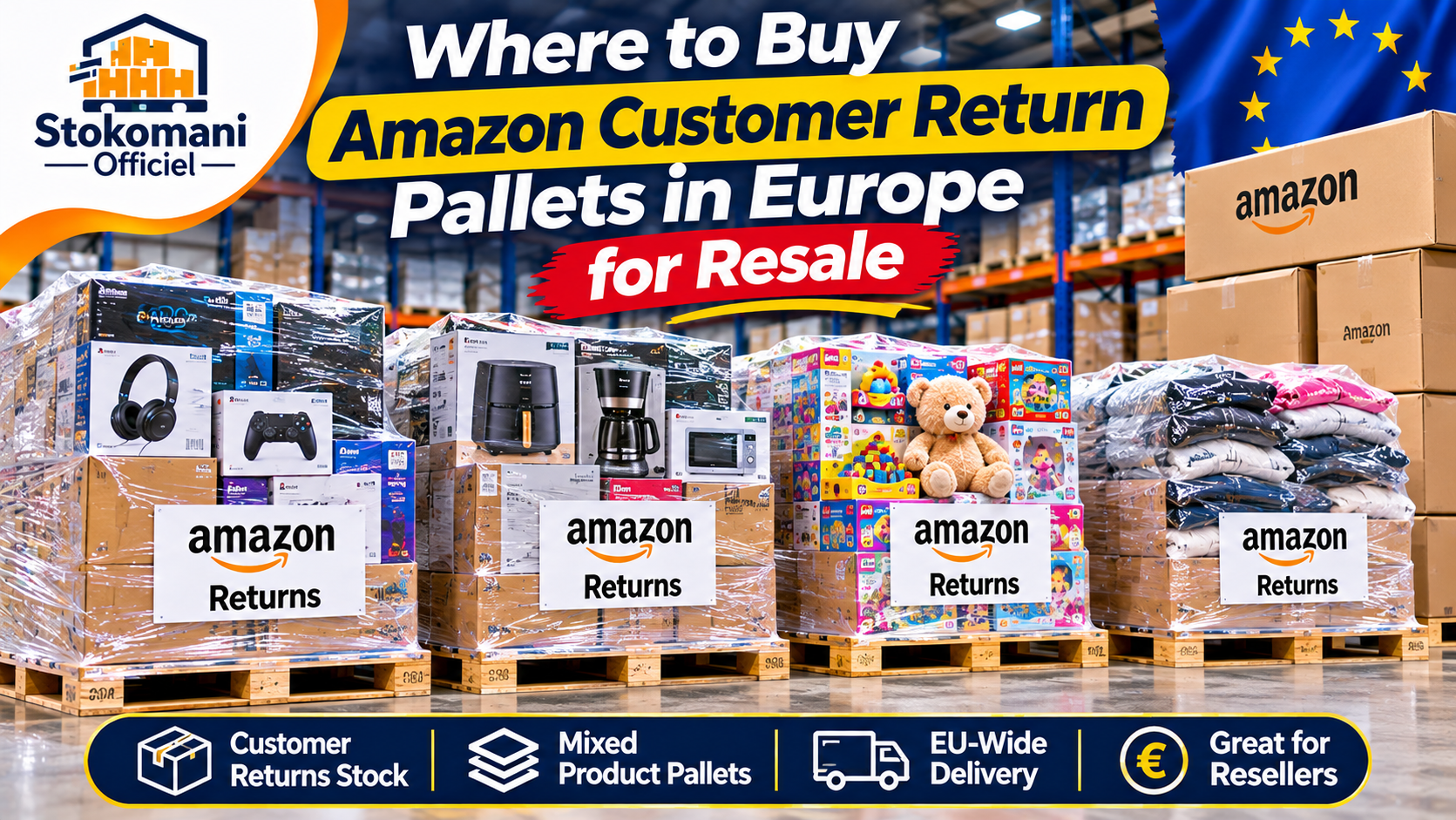
Buying Amazon customer return pallets in Europe has become an interesting sourcing option for wholesalers, independent retailers and online resellers looking to purchase merchandise in bulk.
Customer returns can include electronics, household appliances, kitchen equipment, toys, clothing, computer accessories and many other consumer products. Depending on the original condition and inspection process, returned merchandise may be suitable for resale, refurbishment, spare parts or recycling.
For businesses looking to expand their inventory, purchasing customer return pallets can provide access to a broad range of products through wholesale liquidation channels.
However, not every pallet offers the same buying opportunity. Product condition, stock composition, supplier reliability, transportation costs and resale demand all influence whether a particular purchase makes commercial sense.
In this guide, we explain where to buy Amazon customer return pallets in Europe, what buyers should understand before ordering, how to evaluate suppliers and which factors to consider when purchasing wholesale returned merchandise.
What Are Amazon Customer Return Pallets?
Amazon customer return pallets are bulk collections of merchandise originally purchased by customers and subsequently returned through retail return processes.
Returned products can enter different resale and recovery channels depending on their condition and whether they meet the retailer’s requirements for resale as new merchandise.
Amazon explains that returned products may be inspected and, depending on their condition, relisted, sold through Amazon’s used-product channels, sold to liquidators or donated.
This means customer return pallets can contain merchandise with different levels of wear, packaging conditions and functionality.
Common product categories include:
- Consumer electronics.
- Small household appliances.
- Kitchen equipment.
- Home and garden products.
- Toys and children’s products.
- Computer accessories.
- Sports and outdoor equipment.
- Personal care products.
- Household accessories.
- General merchandise.
The exact contents depend on the source, liquidation lot and supplier. Buyers should never assume that every pallet contains identical products or that all merchandise is in working condition.
Where to Buy Amazon Customer Return Pallets in Europe
There are several routes through which European businesses can source customer return merchandise.
Understanding the differences between these channels can help you identify suitable stock and avoid unnecessary purchasing risks.
1. Official Amazon Liquidation Auctions
One recognised route is the Amazon Europe liquidation marketplace operated through B-Stock.
The marketplace provides registered business buyers with access to liquidation inventory offered through auctions and buy-now listings.
Available merchandise can include customer returns and overstock from different product categories.
Depending on current availability, listings may contain:
- Electronics and computers.
- Home and garden merchandise.
- Kitchen products.
- Toys and children’s products.
- Automotive accessories.
- Sports and outdoor products.
- Mixed merchandise.
Buyers can review individual listings, examine available inventory information and assess the purchasing requirements before placing bids.
Marketplace access and eligibility requirements should be checked directly with the platform.
Official marketplace: https://bstock.com/amazoneu/
2. Specialist Wholesale Liquidation Suppliers
Specialist wholesale liquidation suppliers offer another purchasing route for businesses that want to source returned merchandise in bulk.
These suppliers may purchase liquidation inventory through different wholesale channels before making it available to resellers.
Depending on their inventory, buyers may find:
- Customer return pallets.
- Mixed merchandise pallets.
- Electronics returns.
- Household appliance returns.
- Overstock products.
- Clearance merchandise.
One advantage of purchasing through a wholesale supplier is the possibility of comparing available stock without participating in an auction.
Before placing an order, establish the actual source of the merchandise and whether the supplier can provide supporting documentation.
3. European B2B Wholesale Platforms
European wholesale platforms connect professional buyers with suppliers offering returned merchandise, overstock and liquidation stock.
These platforms may provide access to different pallet quantities and product categories.
Some specialise in customer returns, while others offer new surplus inventory and discontinued retail merchandise.
When comparing platforms, examine:
- Supplier verification requirements.
- Product condition descriptions.
- Manifest availability.
- Minimum order quantities.
- Warehouse locations.
- Delivery destinations.
- Payment arrangements.
- Buyer protection and dispute procedures.
A platform’s presence in Europe does not automatically mean that every seller ships to every European country.
4. Direct Wholesale Liquidation Suppliers
Some businesses purchase liquidation inventory directly from wholesalers and other stock sources.
Buying directly from a supplier can make it easier to discuss available quantities, product categories, order requirements and transportation.
For larger purchases, buyers should request a written quotation and confirm exactly what is included.
Do not rely exclusively on advertised retail values when comparing different suppliers. The actual resale potential depends on the condition, quantity and demand for the products.
Which European Countries Can Buy Customer Return Pallets?
European wholesale buyers can source returned merchandise through domestic and cross-border suppliers.
However, stock availability and delivery arrangements differ by supplier.
The following markets are particularly relevant when researching wholesale liquidation opportunities.
United Kingdom
The UK has an established market for returned merchandise, wholesale clearance and liquidation stock.
Resellers may source customer return pallets containing electronics, homeware, toys, clothing and mixed products.
Popular purchasing considerations include delivery costs, pallet quantities, product manifests and the availability of stock suitable for online resale.
Germany
Germany is an important market for wholesale returns and B-stock merchandise.
German buyers may encounter terms such as Retourenpaletten, Restposten, Sonderposten and Mischpaletten when searching for liquidation stock.
These terms are useful when researching German-language wholesale suppliers.
France
French wholesale buyers can search for customer returns and liquidation merchandise using terms such as palettes de retours clients, lots de déstockage and palettes de liquidation.
Product condition and documentation should be examined before purchasing.
Netherlands
The Netherlands has an active wholesale and distribution environment, making it a relevant market for businesses sourcing returned merchandise and surplus inventory.
Dutch search terms include retourpallets, restpartijen and retourgoederen.
Belgium
Belgian buyers can explore both French-language and Dutch-language wholesale markets.
Depending on the supplier and destination, buyers should confirm delivery arrangements, VAT treatment and the applicable purchasing documentation.
What Products Can You Find in Amazon Return Pallets?
The product mix varies considerably between liquidation lots.
Understanding the main categories can help you decide which type of merchandise best suits your resale business.
Electronics and Computer Accessories
Electronics pallets may contain:
- Headphones.
- Computer accessories.
- Gaming accessories.
- Networking equipment.
- Mobile phone accessories.
- Small electronic devices.
- Home entertainment accessories.
Electronics require careful inspection because missing accessories, damaged components and functionality issues can affect resale value.
For electrical products, buyers should also verify applicable safety and conformity requirements before placing merchandise on the market.
Household Appliances
Household appliance returns can include:
- Air fryers.
- Coffee machines.
- Vacuum cleaners.
- Kitchen appliances.
- Food preparation equipment.
- Cleaning devices.
- Small domestic appliances.
Some products may have opened packaging or cosmetic damage, while others may require testing.
Do not assume that an appliance is functional simply because it appears complete.
Toys and Children’s Products
Toy and children’s merchandise can include games, educational toys, play accessories and other consumer products.
Buyers should check product completeness, age recommendations, safety markings and applicable regulatory requirements.
Damaged or incomplete toys may not be suitable for resale.
Home and Kitchen Merchandise
This category can include cookware, storage products, home accessories, lighting, kitchen utensils and household equipment.
Mixed homeware merchandise can appeal to general retailers because it offers opportunities to stock several product types.
Mixed Merchandise Pallets
Mixed pallets contain products from multiple categories.
They may be suitable for resellers who operate general merchandise shops, online stores or market stalls.
However, the greater variety can also make sorting, testing, pricing and inventory management more demanding.
What Is the Difference Between Customer Returns and Overstock Pallets?
This is an important distinction when comparing liquidation stock.
| Feature | Customer returns | Overstock |
|---|---|---|
| Original status | Previously sold to customers | Surplus unsold inventory |
| Packaging | May be opened or damaged | Often original packaging |
| Product condition | Varies considerably | Usually unused |
| Functionality | May require testing | Still requires inspection |
| Resale preparation | May require sorting or repairs | May require normal stock preparation |
| Purchasing risk | Often higher | Depends on the lot |
Customer returns generally involve greater uncertainty because products have previously been handled or used.
Overstock merchandise may offer more predictable product conditions, although packaging damage and inventory discrepancies can still occur.
Always compare the actual lot description rather than relying on the general category name.
How to Choose the Right Amazon Return Pallet Supplier
Finding available stock is only one part of purchasing liquidation merchandise.
You should also evaluate the supplier and understand the commercial terms before placing an order.
1. Verify the Supplier
Check the supplier’s legal identity, registration information, business address and contact details.
If the supplier claims to have a relationship with Amazon or another major retailer, request appropriate evidence.
Remember that describing merchandise as Amazon returns does not automatically establish that a supplier is an authorised Amazon liquidation partner.
2. Request a Manifest
A manifest provides information about the merchandise included in a liquidation lot.
Depending on the supplier, it may contain:
- Product descriptions.
- Quantities.
- Model numbers.
- Product categories.
- Estimated retail values.
- Condition information.
Manifests can help buyers assess whether a pallet matches their business requirements.
However, a manifest is not necessarily a guarantee that every listed item will arrive or that all products will function.
Some liquidation marketplaces explicitly state that manifests are provided for reference and that customer-return merchandise may contain defective, incomplete or damaged products.
3. Understand the Grading System
Suppliers may use different grading descriptions for customer returns.
Common descriptions include:
Grade A: Merchandise described as being in excellent or near-new condition, subject to the supplier’s grading definition.
Grade B: Products that may have opened packaging, minor cosmetic damage or signs of handling.
Grade C: Merchandise that may have noticeable damage, missing components or functionality issues.
Untested: Products that have not undergone functionality checks.
These labels are not universal industry guarantees. Always request the supplier’s specific grading criteria.
4. Calculate the Total Purchase Cost
Before buying, calculate the complete cost of acquiring the merchandise.
Include:
- Pallet purchase price.
- Freight and transportation.
- VAT and applicable taxes.
- Customs charges where relevant.
- Storage expenses.
- Sorting and testing.
- Repair costs.
- Marketplace selling fees.
- Packaging and delivery to your customers.
A low advertised pallet price does not necessarily mean a good wholesale opportunity.
5. Check Delivery and Collection Arrangements
International buyers should confirm the warehouse location and destination coverage.
Ask whether the supplier offers delivery to your business address, whether unloading equipment is required and whether transportation insurance is available.
For larger orders, obtain a written freight quotation before completing payment.
6. Review the Payment and Dispute Terms
Before confirming an order, request an invoice and written purchasing terms.
Check how the supplier handles:
- Incorrect pallet quantities.
- Missing merchandise.
- Transport damage.
- Incorrect product descriptions.
- Delivery delays.
- Order cancellations.
Pay particular attention to final-sale conditions. Some liquidation auctions sell merchandise as-is, which can significantly affect the buyer’s ability to claim a refund.
Are Amazon Return Pallets Profitable in Europe?
Customer return pallets can create resale opportunities, but profitability depends on several variables.
The original retail value is not the same as the amount a reseller can realistically recover.
A sensible purchasing decision should account for:
- The actual purchase price.
- The condition of the merchandise.
- The percentage of products suitable for resale.
- Realistic resale prices.
- Testing and refurbishment costs.
- Transportation expenses.
- Selling fees and taxes.
- Unsold inventory.
Example of a Liquidation Pallet Calculation
Consider a hypothetical customer return pallet purchased for €600.
| Cost or revenue | Amount |
|---|---|
| Pallet purchase | €600 |
| Freight | €100 |
| Sorting and testing | €50 |
| Total initial cost | €750 |
| Merchandise sold | €1,100 |
| Difference before other expenses | €350 |
The €350 difference is not net profit. Additional costs, taxes, selling fees, customer returns and unsold inventory must still be considered.
The purpose of this calculation is to demonstrate why buyers should evaluate the total cost rather than focusing only on the purchase price.
Common Mistakes to Avoid When Buying Amazon Return Pallets
Buying Based on Advertised Retail Value
A pallet advertised with a high original retail value is not necessarily worth its purchase price.
Research realistic second-hand and clearance selling prices before committing.
Ignoring Product Conditions
A customer return is not automatically a working product.
Some merchandise may be incomplete, damaged or unsuitable for resale.
Purchasing Without Understanding the Manifest
If a manifest is available, review it carefully.
Pay attention to product categories, quantities, estimated values and any limitations stated by the supplier.
Forgetting Transportation Costs
International freight can significantly affect the economics of a pallet purchase.
Obtain a complete delivery quotation before ordering.
Buying More Stock Than You Can Handle
Large liquidation purchases require storage, sorting, inspection and inventory management.
Make sure your business can process the quantity before purchasing.
Buying Amazon Return Pallets for Resale: Which Business Model Is Best?
The right resale channel depends on the merchandise and your existing customer base.
Selling Through eBay
eBay can be useful for individual products, second-hand merchandise and consumer electronics.
Accurate condition descriptions and clear product photographs are important.
Selling Through Amazon
Amazon sellers must follow the platform’s product condition, authenticity, listing and category requirements.
Not every returned product will qualify for resale through Amazon, particularly where condition or documentation cannot be established.
Selling Through Your Own Online Store
An independent ecommerce website gives retailers control over product presentation, pricing and customer relationships.
However, businesses must generate their own traffic and manage customer service, fulfilment and returns.
Selling Through Physical Retail
Market traders and independent retailers can sell suitable liquidation merchandise directly to customers.
This approach may be particularly useful for general merchandise and household products.
Frequently Asked Questions About Amazon Customer Return Pallets in Europe
Where can I buy Amazon customer return pallets in Europe?
Buyers can explore Amazon’s official European liquidation auction marketplace through B-Stock, specialist wholesale liquidation suppliers and European B2B returns platforms. Always verify the source and purchasing conditions.
Can I buy Amazon return pallets directly from Amazon?
Amazon’s European liquidation merchandise is available through its designated liquidation marketplace arrangements. Buyers should consult the official Amazon Europe marketplace and its current eligibility requirements rather than assuming that pallets can be purchased directly from ordinary Amazon retail listings.
Are Amazon return pallets available in Germany?
Yes. European liquidation listings can include merchandise stored in Germany, subject to current stock availability and marketplace eligibility. Buyers should check the warehouse location and delivery conditions.
Can I buy Amazon return pallets in the UK?
Yes. Customer-return liquidation merchandise is available through UK wholesale and liquidation channels. Check the specific stock location, supplier documentation and delivery costs before ordering.
Do Amazon return pallets contain working products?
Not necessarily. Customer return pallets may include working, incomplete, damaged or untested merchandise. Read the condition description carefully and calculate potential losses when evaluating a purchase.
Are Amazon return pallets manifested?
Some liquidation pallets include manifests, while others are sold without detailed product lists. Even when a manifest is provided, it may be indicative rather than a guarantee of every item received.
Can beginners buy customer return pallets?
Beginners can enter the liquidation market, but they should understand the risks before making a substantial purchase. Starting with a manageable quantity and learning how to inspect and price merchandise can help reduce avoidable mistakes.
Can I resell Amazon customer return products?
Many products can be resold when the seller has the legal right to sell them and meets relevant product safety, authenticity, intellectual property and marketplace requirements. Brand restrictions and product-specific rules may apply.
What is the difference between Amazon returns and Amazon overstock?
Amazon returns refer to merchandise previously purchased and returned by customers. Overstock generally refers to surplus inventory that has not been sold through the original retail channel. The condition and risks can therefore differ.
Do liquidation suppliers deliver across Europe?
Some suppliers offer cross-border European delivery, but coverage varies. Confirm the exact destination, freight charges, delivery conditions and customs arrangements before purchasing.
Final Thoughts: Finding the Right Amazon Customer Return Pallets in Europe
Buying Amazon customer return pallets can offer European resellers access to a wide range of wholesale merchandise.
From electronics and appliances to household products, toys and mixed inventory, different liquidation categories can serve different retail business models.
The most important part of purchasing is understanding the merchandise and the conditions under which it is sold.
Compare suppliers, request manifests where available, verify product grading, calculate transportation costs and assess realistic resale demand before committing to a purchase.
Whether you are an established wholesaler or an independent online reseller, informed purchasing decisions can help you manage inventory more effectively and identify suitable opportunities in the European liquidation market.
Explore wholesale liquidation opportunities
If you are sourcing returned merchandise or mixed wholesale stock, compare available product categories, review the purchasing terms and contact the supplier to confirm current inventory, quantities and delivery options before ordering.